

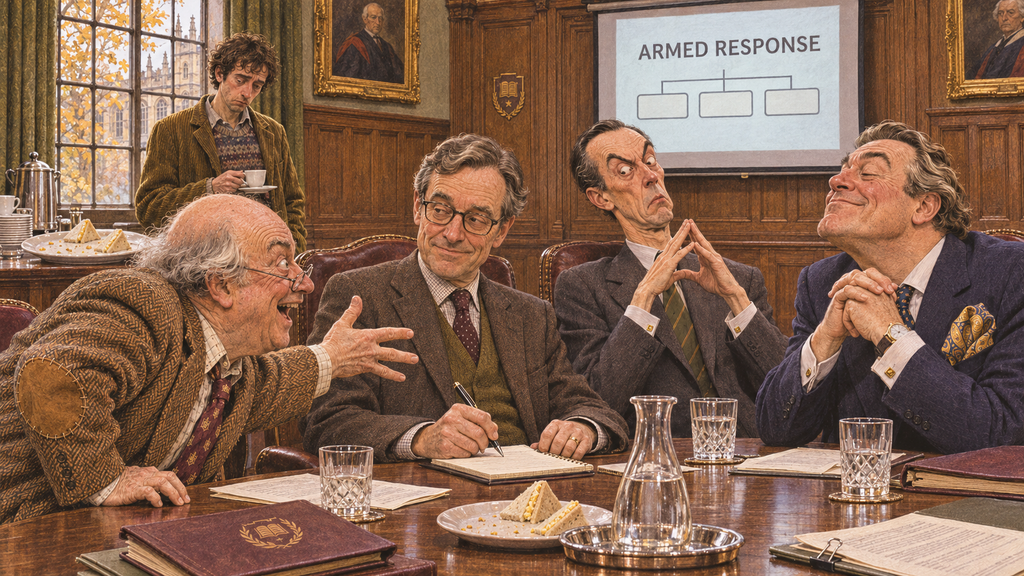
‘And that, in short, is my strategy. I’d be keen to hear any feedback from my esteemed colleagues.” Professor Adams said the last word, hoping the audience would pick up on the slight inflexion he placed on “esteemed.” He wanted nothing of the sort, of course. He’d spent a whole afternoon of his precious time putting together this strategy. It was bad enough that it had taken his useless postdoc minion the best part of a week to prepare the slides, but the thought that any of these mindless peons could contribute effectively to his strategy was bile-inducing. He was annoyed to see a hand raised. It was a non-academic, of all people. He had the title of industrial partnership lead or something. Just one of the pointless professions that universities were littered with. He assumed the university employed these people as some community charitable enterprise. He had no problem with that, but the least they could do was keep their opinions to themselves. Unfortunately, the idiot seemed persistent, so Adams had to entertain his juvenile question.
“Correct me if I’m wrong, Professor,” he laughed nervously, “you seem to be advocating an armed response against the government because they’ve denied you a funding proposal…”
Adams blinked for several moments, awaiting the question. When the fool realised that Adams wasn’t going to respond to his comment, he eventually asked: “Is this an…appropriate level of response?”
Adams sniffed disdainfully. He decided he would let an awkward silence answer this ignorant question instead. He looked around the room and caught the eye of Professor Rowod. He thought he’d see equal amounts of disdain in his eyes, but he was surprised to see he was about to ask a question.
***
Professor Rowod wasn’t sure whether he should reserve his disdain for the simpleton who’d just asked a question or this fool who was presenting the strategy. It was time for him to bring some sanity back into the room.
He sniffed before speaking. He’d always found that sniffing before delivering unpleasant news was a useful way of conveying dissatisfaction to his audience. “I’m afraid I don’t really see how you came about with this strategy.” He was hoping that just this simple statement would be enough to make Adams reconsider and withdraw his ludicrous proposal.
“I don’t take your meaning,” replied the so-called professor.
Rowod steepled his fingers under the bridge of his nose. “The kindest thing I can say about your strategy is that the cause is worthy. Beyond that, I’m frankly astonished you could come up with such an unrealistic plan.”
“It is clear that you are the type of academic who lives for the theoretical. I highly recommend that you spend some time in the world of applied research. I know that you junior professors are more concerned with publishing outcomes, but those of us with a bit more experience like to work on things that deliver real impact.” The look on the face of Adams was almost worth the effort of coming to this meeting. Now, he would start with the incineration of this strategy: “First of all, the notion of an armed response is infantile. Have you even thought about where you’d even acquire the necessary hardware? Also, the notion that armed response would create the right conditions to allow research funding to be released, whilst in theory, sounds valid, I assume no level of risk analysis has even taken place. What if one of the funding administrators who is sitting on a scathing review of a project becomes incapacitated due to your cowboy approach? That research could get funded through administrative ignorance, which, as we all know, is a worse outcome than the funding being withheld in general.”
“Here, here.” Another professor had piped up now. Rowod thought this would happen. Often, being the one to open the floodgates fell to the foremost senior academic.
“You haven’t thought about industrial validation.”
“There isn’t even a strong enough technoeconomic analysis.”
“Has anyone considered the mass balance?”
“My lab won’t be big enough for this kind of experiment.”
Rowod allowed the other academics to have their say. At this point, Adams’s dejection was a particularly delicious flavour. After a lull in the criticisms, he prepared himself to offer his own insights into a strategy.
***
Bastion couldn’t believe what he was hearing. He was flabbergasted to realise that he hadn’t been mistaken when he’d overheard the professors talking about militias; he was even more shocked to realise that these people were serious. He’d thought that the VPR would interject and put this whole idea to bed, but the only issue this pompous peacock seemed to have was that it wasn’t his idea. He’d just started offering his own alternative strategy on how to conduct an armed revolt when, inevitably, one of the other professors in attendance interrupted to criticise what was being said and put their own idea forward. Being perceived to be right was the holy grail for these people.
He was so proud when he’d first joined the university. He was under the impression that he was joining a noble institute that valued knowledge and discovery over the pettiness of the rest of humanity. What he’d actually found was a teeming mass of ego and ineptitude. These were some of the greatest scientific minds of a generation, and yet they squabbled like toddlers. For goodness sake, they were entertaining the idea of an armed revolt because someone had decided not to award a research grant.
Bastion rubbed his head at the onset of a headache. He kept waiting for sanity to descend but the more this meeting went the more he realised that it wasn’t forthcoming. It occurred to him that it would be fun to see how far he could push them. He raised his hand and interrupted the discourse. “Whilst I recognise the merits of an armed revolt, I find it is an inelegant solution.” He’d put on his most pompous tone to match this crowd and was surprised to see several nods from around the room. “I think before we make any drastic decisions on strategy, we need to convene a small working group.” The nods were now more vigorous. “I propose that we appoint a steering committee that will also validate the outputs of the working group before we report to an executive board.” Even Rowod was nodding now, no doubt mentally appointing himself to the executive board. “We should come up with a timescale in which we need to deliver results. You know best, of course, but I do believe that there are many publishing opportunities in this space.” Adams could no longer contain himself “An excellent notion, and I hope you’d do us the honour of becoming this group’s secretariat.”
Bastion blinked in disbelief.

